 derek.holloway
7502bf64a4
derek.holloway
7502bf64a4
3.0 KiB
Security model for system-wide tracing on Android/Linux
The tracing service has two endpoints (in Chromium: Mojo services, on Android/Linux: UNIX sockets): one for producer(s) and one for consumer(s). The former is typically public, the latter is restricted only to trusted consumers.
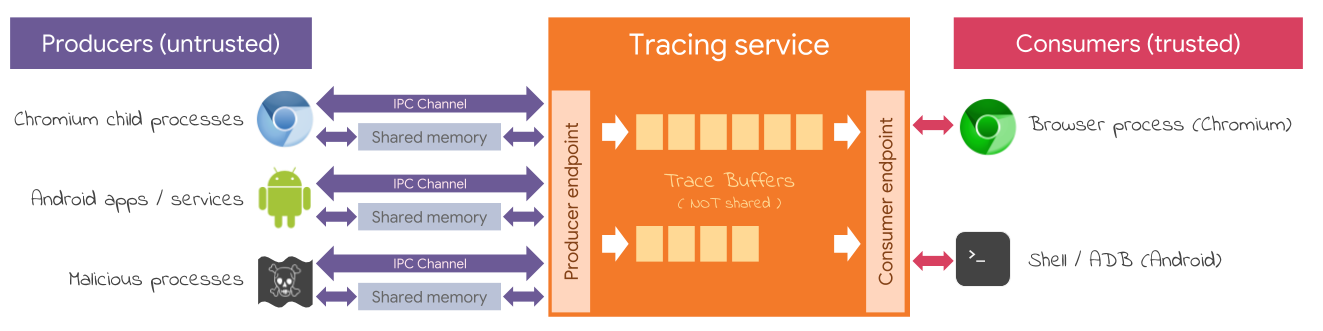
Producers
Producers are never trusted. We assume they will try their best to DoS / crash / exploit the tracing service. We do so at the service/tracing_service_impl.cc so that the same level of security and testing is applied regardless of the embedder and the IPC transport.
Tracing service
- The tracing service has to validate all inputs.
- In the worst case a bug in the tracing service allowing remote code execution, the tracing service should have no meaningful capabilities to exploit.
- The tracing service, by design, has a limited syscall surface to simplify
its sandboxing:
- It doesn't open or create files (% tmpfs).
- It writes only onto file descriptors passed over the IPC channel.
- It doesn't open or create sockets (on Android the IPC sockets are passed by init, see perfetto.rc)
- On Android it runs as nobody:nobody and is allowed to do very little see traced.te.
- In Chromium it should run as a utility process.
Consumers
Consumers are always trusted. They still shouldn't be able to crash or exploit the service. They can easily DoS it though, but that is WAI.
- In Chromium the trust path is established through service manifest.
- In Android the trust path is established locking down the consumer socket to shell through SELinux.
Shared memory isolation
Memory is shared only point-to-point between each producer and the tracing service. We should never ever share memory across producers (in order to not leak trace data belonging to different producers) nor between producers and consumers (that would open a hard to audit path between untrusted-and-unprivileged and trusted-and-more-privileged entities).
Attestation of trace contents
The tracing service guarantees that the TracePacket fields written by the
Service cannot be spoofed by the Producer(s).
Packets that try to define those fields are rejected, modulo clock snapshots.
See PacketStreamValidator and
its unit test for more
details.
At the moment nothing prevents that a producer writes TracePacket(s) that do
not belong to its data sources. Realistically the service will never prevent
that because doing so would imply that the service knows about all the possible
types of packets, which doesn't scale.
However, the service appends the POSIX uid of the producer to each TracePacket
to perform offline attestation of the contents of the trace.